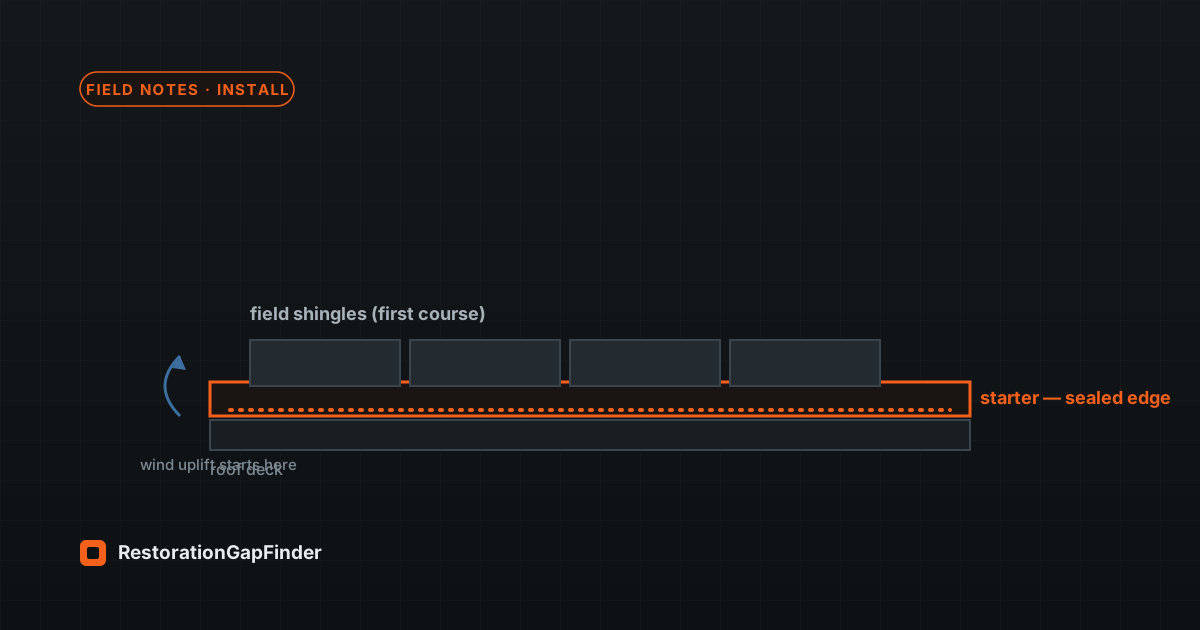
What a starter strip actually does
The starter strip is the first course laid at the eaves — and usually up the rakes — before the visible field shingles. It's not the same as the first row of field shingles laid backward, even though that shortcut is still common in the field.
A dedicated starter product does two things a cut field shingle does not do reliably:
- Seals the edge course down. The starter has a factory adhesive bead placed so it grabs the underside of the first field course right at the edge — the exact line where wind wants to lift shingles first.
- Backs the joints. Its continuous, cutout-free edge sits under the gaps between the first-course shingles, so wind-driven water hitting those seams meets solid material instead of underlayment.
The eaves and rakes are where uplift and water intrusion start. The starter course is the part that's engineered for that line.
Why it's more than a preference
Shingle manufacturers specify a starter course — often a matching starter product — as part of the installation instructions tied to the wind-performance rating and the material warranty. Skipping it, or substituting cut three-tab, can fall outside those instructions. Many jurisdictions require roofing to be installed per the manufacturer's instructions, which is the honest reason "just use cut shingles" isn't equivalent on a code-and-warranty basis.
Two caveats worth stating plainly:
- The specifics are the manufacturer's. Which starter product, how much overhang, and the adhesive placement are set by the shingle maker's current instructions for the product being installed — confirm those, not a general description.
- Local code adoption varies. Whether and how "per manufacturer instructions" is enforced depends on your adopted code and building department.
Why it gets left off an estimate
Starter is easy to omit because it's literally underneath the finished roof. From a photo you can't see it at all. Two common gaps:
- Folded into field shingles. The scope prices field shingle square footage and assumes starter is "in there," but starter is a separate material and, on many estimates, a separate line.
- Eaves only. Starter is included at the eaves and left off the rakes, even where the manufacturer calls for it on both.
How to document it
- Identify the shingle manufacturer and product, and pull its current starter requirement (eaves, rakes, overhang, adhesive).
- Measure the starter linear footage for the edges the instructions cover.
- Check the existing estimate for a distinct starter line — not just field shingle area.
- Where it's missing, add it with the manufacturer instruction and the measured edge as the justification.
Where a tool helps
Catching an omitted starter course means knowing it's a specified, separate item, and confirming the estimate didn't quietly bundle it into field shingles. RestorationGapFinder runs that check as it reads the estimate — flagging manufacturer- and code-driven items like starter with their justification, and no dollar figures in the export. It points to what to verify; the manufacturer's current instructions and your local code have the final word.
This article is general information for contractors, not legal, code, or insurance advice. Installation requirements vary by product and jurisdiction — always confirm against the shingle manufacturer's current instructions, your locally adopted code, and the specific policy.