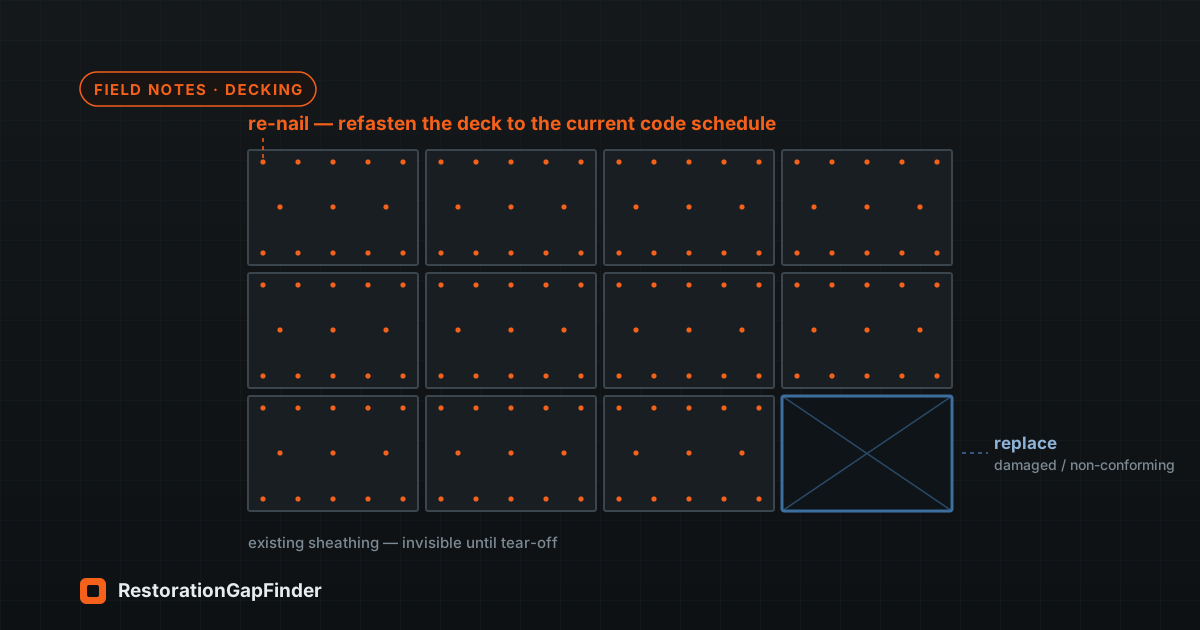
The deck is the one part a photo can't show
Every other item on a roof estimate is at least visible from the ground or a drone: shingles, flashing, the ridge, the eaves. The decking — the plywood or board sheathing the whole roof is nailed to — is the one layer you can't see until the old roof is off. So a quick scope prices what it can see and quietly assumes the deck underneath is sound and up to code. On a tear-off, that assumption is where two separate line items go missing:
- Re-nailing (re-fastening) the existing deck to the current fastening schedule — a code upgrade that a tear-off can trigger.
- Replacing damaged or non-conforming sheathing — rotted, delaminated, warped, or improperly spaced boards that can't take the new roof.
They're different items with different triggers, and each is easy to leave off.
Re-nailing is a code item, not a courtesy
When a roof is torn down to the deck, many jurisdictions require the existing sheathing to be re-fastened to the current code's nailing schedule before new underlayment goes down — because the deck is now exposed and accessible, and older roofs were often fastened to a lighter standard than today's code (especially in high-wind regions, where this requirement is most common and most explicit). It's the same logic as any code upgrade: once the work opens it up, it has to come back to current standard.
Two honest caveats, as with any code item:
- Your adopted code and the authority having jurisdiction govern. Whether a re-nail is required, and to what schedule, depends on the locally adopted building code and the inspector — confirm it, don't assume it. Some jurisdictions require it on every tear-off; others don't require it at all.
- It's a deck-wide labor item, not a materials afterthought. Re-nailing is measured across the whole roof area (the field, not just the edges), so when it applies it's a real line — not something folded into the tear-off.
Replacement is condition-driven — and usually unknown until tear-off
Separately from re-nailing, the deck itself may have to be replaced in spots: sheathing that's rotted from a prior leak, delaminated plywood, warped or cupped boards, or board decking with gaps too wide to hold fasteners or support the new roof. You often can't know how much until the old roof is off, which is exactly why it gets left off a photo-based scope.
The honest way to handle the unknown isn't to ignore it — it's to carry a documented allowance (for example, a stated number of sheets or board feet) that's reconciled against what's actually found and photographed at tear-off, rather than discovering rotten deck mid-job with nothing on the estimate to cover it.
Why both get missed on an estimate
From a photo you can't see the deck at all, so a quick scope tends to:
- Omit the re-nail — pricing the tear-off and new roof while assuming the existing fastening is fine, even in a jurisdiction where a re-nail is standard on a tear-off.
- Carry nothing for replacement — no allowance for bad sheathing, so any rotten or non-conforming deck becomes an awkward mid-job change order instead of a documented, agreed line.
How to document it
- Confirm the locally adopted code on re-nailing for a tear-off, and the fastening schedule it points to, so a re-nail line is justified rather than assumed.
- Measure it deck-wide — re-nailing is the roof area, not a perimeter item.
- Carry a replacement allowance for sheathing, stated as a quantity, to be reconciled and photographed at tear-off.
- Check the existing estimate for a distinct re-nail line and a distinct deck-replacement line — not a silent "the deck is fine."
Where a tool helps
Catching a shorted deck means separating two items that are invisible in a photo — a code-driven re-nail and a condition-driven replacement allowance — and confirming the estimate didn't just assume the deck away. RestorationGapFinder reads the estimate and flags where decking isn't accounted for, each with its justification, and no dollar figures in the export. It points to what to verify; your locally adopted code and the actual condition at tear-off have the final word.
This article is general information for contractors, not legal, code, or insurance advice. Re-nailing requirements, fastening schedules, and replacement decisions vary by jurisdiction, condition, and the authority having jurisdiction — always confirm against your locally adopted building code, the actual deck at tear-off, and the specific policy.