Flashing is where roofs actually leak
Most roof leaks don't start in the field of the shingles — they start at the transitions: where the roof meets a wall, a valley, a chimney, or a pipe. Those transitions are sealed by flashing, and on a re-roof each type has to work with the new shingles. The common mistake isn't using the wrong flashing — it's assuming the old flashing gets reused when it shouldn't.
The main types that show up on an estimate:
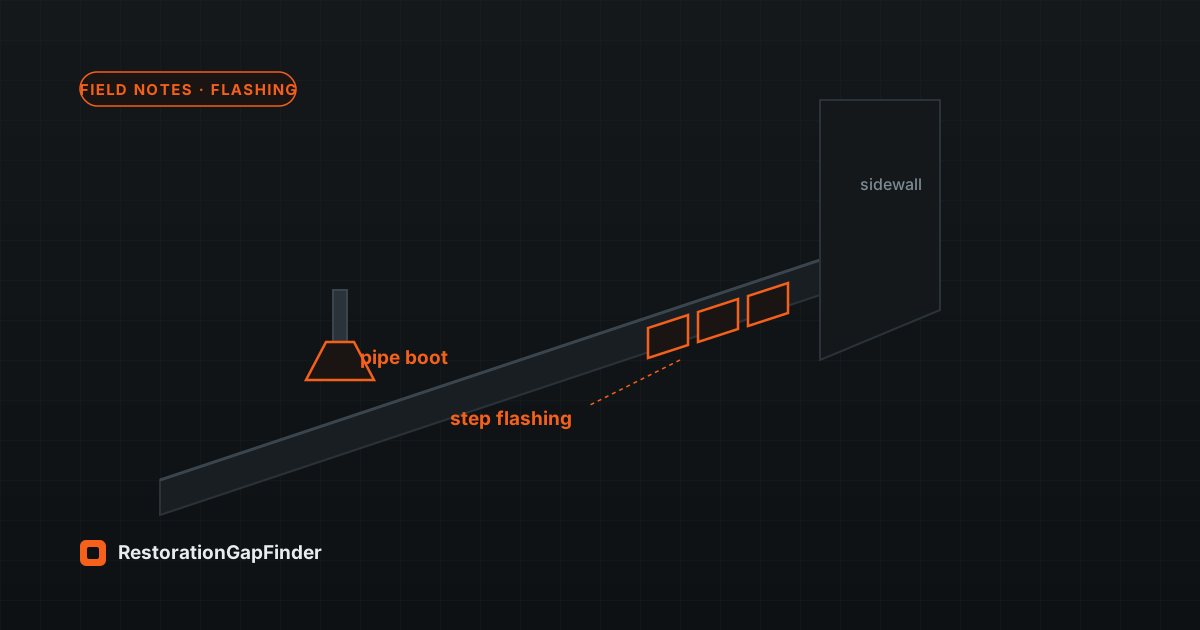
- Step flashing — the small L-shaped pieces woven into each shingle course where the roof meets a sidewall. Each piece interleaves with a specific course, so it's effectively tied to the shingles it was installed with.
- Counter-flashing / headwall (apron) flashing — the piece that covers the top of step flashing at a wall, or the flashing where the roof meets a wall head-on.
- Valley metal — the metal lining an open valley, where two roof planes drain together and water concentrates.
- Pipe boots (pipe jacks) — the collared flashing around plumbing vents and other penetrations, usually with a rubber/neoprene gasket.
Why reusing it is usually the wrong call
On a full tear-off, the new shingles are laid fresh — and flashing that was woven into the old shingles often can't be reused correctly:
- Step flashing is interleaved course-by-course; pulling old steps and re-laying them into new courses rarely reseats properly, and they're often bent or embedded in siding. New step flashing with the new roof is the clean call.
- Pipe boots are the classic false economy. The rubber collar is the part that fails first — it dries, cracks, and lets water in — so an old boot on a new roof is a leak waiting to happen. These are cheap to replace and almost always should be.
- Valley metal and counter-flashing depend on condition: sometimes reusable, often not once disturbed. The point is to assess, not assume.
An honest caveat: whether a given piece is reused or replaced is a condition-and-code call. Some counter-flashing set into masonry is meant to stay; some valley metal is fine. The problem isn't reuse itself — it's reuse by default, without looking.
Why it gets missed on an estimate
From a photo you often can't see the flashing at all, or can't tell its condition. So a quick scope tends to price the shingles and leave flashing as an assumed reuse — no line for new step flashing, no pipe-boot replacement — even on a tear-off where new flashing is standard practice.
How to document it
- Inventory the transitions — sidewalls (step), headwalls, valleys, chimneys, and every penetration (pipe boots, etc.).
- Assess condition and method — note what genuinely can be reused versus what the tear-off or its condition means must be replaced.
- Check the estimate for distinct flashing lines that match the transitions on this roof — not a silent "reuse everything."
- Justify each with the condition and standard practice (e.g., new step flashing with a new roof, pipe boots replaced on tear-off).
Where a tool helps
Catching missing flashing means accounting for every transition on the roof and matching each to whether it's realistically reusable. RestorationGapFinder reads the estimate and flags where flashing at these transitions isn't accounted for, each with its justification, and no dollar figures in the export. It points to what to verify; the actual condition and your local code decide reuse versus replace.
This article is general information for contractors, not legal, code, or insurance advice. Flashing requirements and reuse-versus-replace decisions vary by condition, jurisdiction, and manufacturer — always confirm against the actual roof, your locally adopted code, and the specific policy.