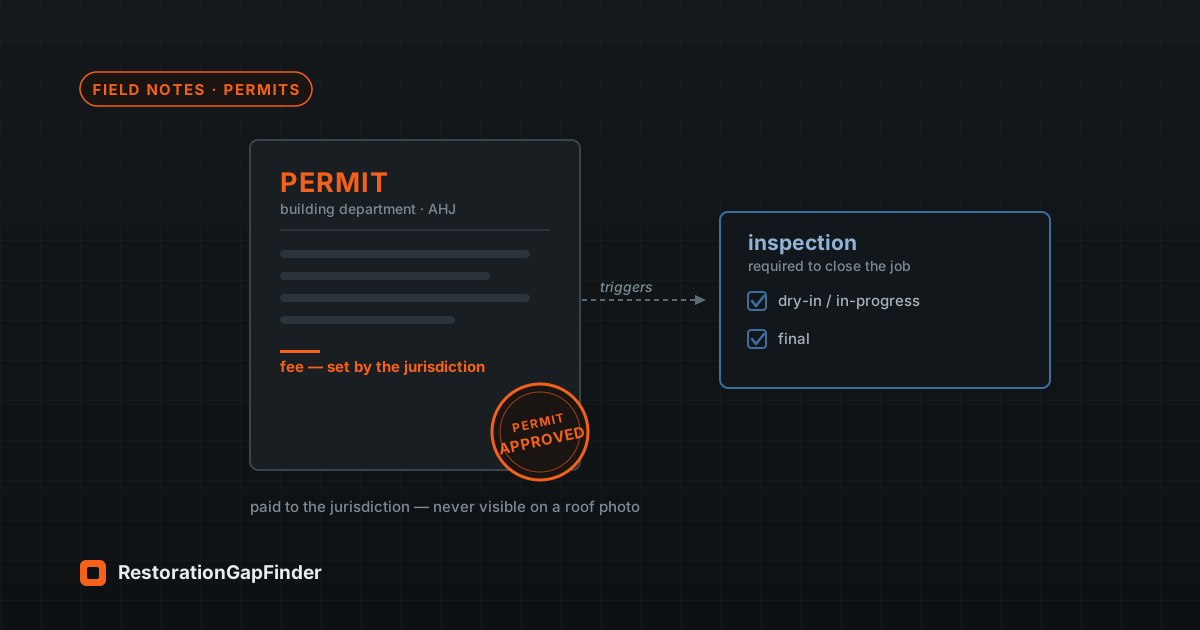
The one line that isn't on the roof
Every other item on an estimate is something you install on the building. The permit is the one required cost that lives at city hall — so a photo-based scope, which prices what it can see on the roof, tends to leave it off entirely. But in most jurisdictions a tear-off or reroof is permitted work, and the permit is a real, documented cost of doing the job legally. It usually comes with a second line most scopes also miss:
- The permit itself — a fee paid to the authority having jurisdiction (AHJ) for the right to do the work.
- The inspection(s) the permit triggers — often an in-progress or dry-in check and a final, sometimes with their own fee.
They're separate, required, and easy to leave out of a quick estimate.
The permit is a jurisdiction cost, not a labor markup
A roofing permit is paid to the local building department, and the fee is set by that jurisdiction — commonly a flat amount, a valuation-based fee, or a per-square charge. It isn't part of the roofer's labor rate and shouldn't be assumed "included" in the tear-off. Pulling it is also usually required to be done by a licensed contractor (or the owner), and doing permitted work without one can mean a stop-work order or a failed resale inspection later.
Two honest caveats, as with anything jurisdiction-driven:
- Your AHJ governs — confirm, don't assume. Whether a permit is required for this specific scope, who may pull it, and what it costs all depend on the local building department. Some jurisdictions exempt minor repairs (for example, below a stated area or a "repair" that isn't a full replacement); others require a permit for any reroof.
- It's documented, not estimated. Unlike a field quantity, the permit fee is a published number you can confirm with the department — so it belongs on the estimate as a real line, with the requirement as its justification.
The inspection is the second half
Pulling a permit usually obligates one or more inspections before the job can be closed out — commonly a deck/dry-in inspection while the roof is open and a final once it's complete. Depending on the jurisdiction these carry their own fee or re-inspection fee, and the job isn't legally finished until the final passes. A scope that carries the permit but forgets the inspection is still short.
Why both get missed on an estimate
From a photo you're looking at the roof, not the permit counter, so a quick scope tends to:
- Omit the permit — pricing materials and labor while assuming the permit is "in there" or not thinking of it at all, even in a jurisdiction that requires one for a reroof.
- Forget the inspection — carrying (or assuming) the permit but leaving off the inspection(s) the permit requires to close the job.
How to document it
- Confirm the AHJ's requirement — whether this scope needs a permit, and who may pull it, from the local building department.
- Get the fee from the published schedule — flat, valuation-based, or per-square — rather than estimating it.
- Include the inspection(s) the permit triggers, with any separate fee.
- Check the existing estimate for a distinct permit line and a distinct inspection line — not a silent "that's included."
Where a tool helps
Catching a missing permit means knowing that a reroof is usually permitted work and that the permit brings an inspection with it — two required costs that a roof photo will never show. RestorationGapFinder reads the estimate and flags where a permit or inspection line is absent for a scope that would normally require one, each with its justification, and no dollar figures in the export. It points to what to verify; your local building department has the final word on what's required and what it costs.
This article is general information for contractors, not legal, code, or insurance advice. Permit requirements, who may pull a permit, fees, and required inspections vary by jurisdiction and scope — always confirm with your local building department (the authority having jurisdiction) and the specific policy.